Progress on an open problem, 14 November 2026
Force groups, three colours and exactly three generations
The second open problem, the origin of the force groups, has been narrowed further. The carrier counts read off the particle matrices allow only SU(3) and SU(2) × U(1). Requiring the medium to have no gaps and its relationships to keep their size restricts its inner algebra to the four division algebras (Hurwitz, 1898); a force richer than the weak force requires the octonions, and fixing any one direction leaves SU(3) acting on three complex directions, which gives three colours. Octonionic Hermitian matrices satisfy the Jordan identity only up to 3 × 3 (Jordan, von Neumann and Wigner, 1934), and CP violation needs at least three generations (Kobayashi and Maskawa, 1973): together, exactly three.
The criterion stays at “partly met”. The gauge principle itself, the translation of the physical picture into algebraic rules, and the left-handedness of the low-energy world are still assumed. Full details are on the Results page.
Result, 14 November 2026
Neutrino partners and the matter–antimatter excess
If the neutrino shares the relation matrix of the charged leptons, the seesaw mechanism fixes the masses of its heavy partners (7.3 × 10⁵ to 6.3 × 10¹⁰ GeV). The heaviest fits the left–right breaking scale of 1011.7 GeV that follows from unifying the three measured force strengths. Leptogenesis from these partners, solved with the full flavoured rate equations, gives a matter–antimatter excess of about 2 × 10⁻¹⁰ against the observed 6.1 × 10⁻¹⁰: within a factor of about three, but not yet reached.
The same rule fails for quark pairs, so it is stated for leptons only. Several related ideas were tested and rejected: neutrino mass set by today's temperature, and an equal amount of cold, hidden antimatter.
Correction, 14 November 2026
The pairing-gap window, recomputed
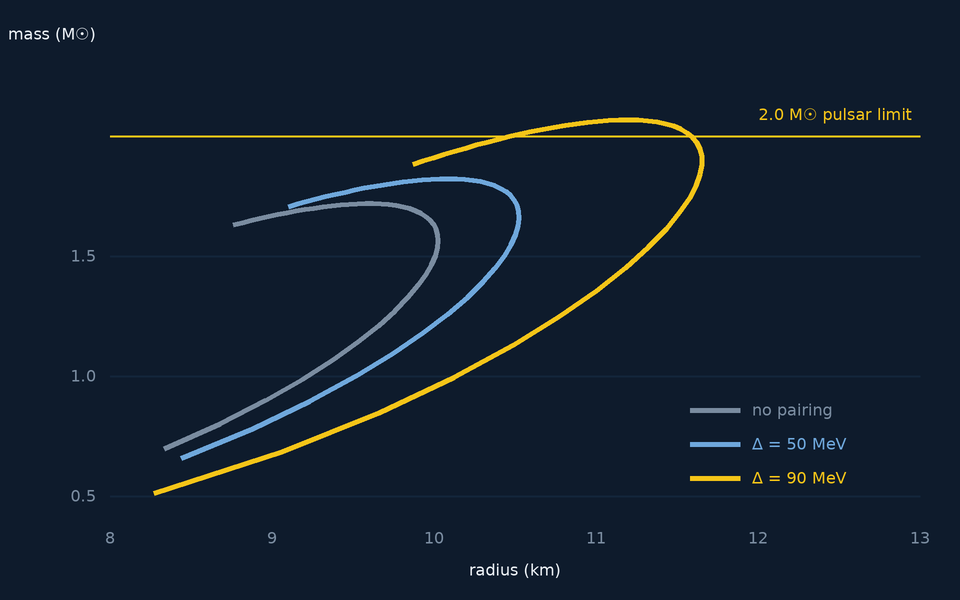
A finer rerun of the neutron-star calculation shows that the pairing-gap window published earlier, 70–90 MeV, was not right at its edges. At the central containment pressure (B = 60.1 MeV/fm³), a 70 MeV gap gives a maximum mass of only 1.92 M☉, below the 2.0 M☉ pulsar limit. At the low end of the allowed range (B = 57.1), a 90 MeV gap gives a tidal deformability of Λ1.4 = 595, above the GW170817 bound of about 580.
With the scan refined, both limits are met for a gap of about 80–100 MeV at the central B, and of about 75–110 MeV across the full range of B allowed by the proton and Δ masses. Over that window the maximum mass is 2.0–2.15 M☉, Λ1.4 is 440–580 and the radius of a 1.4 M☉ star is 10.8–11.3 km. The prediction itself is unchanged: quarks in neutron-star cores must pair. The scan is published as neutron_stars_pairing_gap_scan.py, and the result can be explored in the neutron-star lab.
Result, 14 November 2026
The containment pressure, fixed by the proton
In the bag model of Chodos, Jaffe, Johnson, Thorn and Weisskopf (1974), a hadron is held together by a constant pressure B. In this framework that pressure is the containment of the proton's own scale, so it should follow from the proton rather than be fitted. Requiring the bag model to reproduce both the proton and the Δ(1232) masses gives B = 60.1 MeV/fm³, with a range of 57.1–63.7 MeV/fm³ from the model's known uncertainties. This agrees with the value of about 57 MeV/fm³ found in the original 1975 fit to the light hadrons.
The same B, carried into neutron-star matter with perturbative QCD corrections (Fraga, Pisarski and Schaffner-Bielich, 2001), gives stars that are too light unless quarks in the core pair, as in the colour-superconducting phases described by Alford, Rajagopal and Wilczek (1998). The figure shows the mass–radius curves for no pairing and for gaps of 50 and 90 MeV.
Prediction, 14 November 2026
Normal ordering, and a lightest neutrino of 0.36 meV
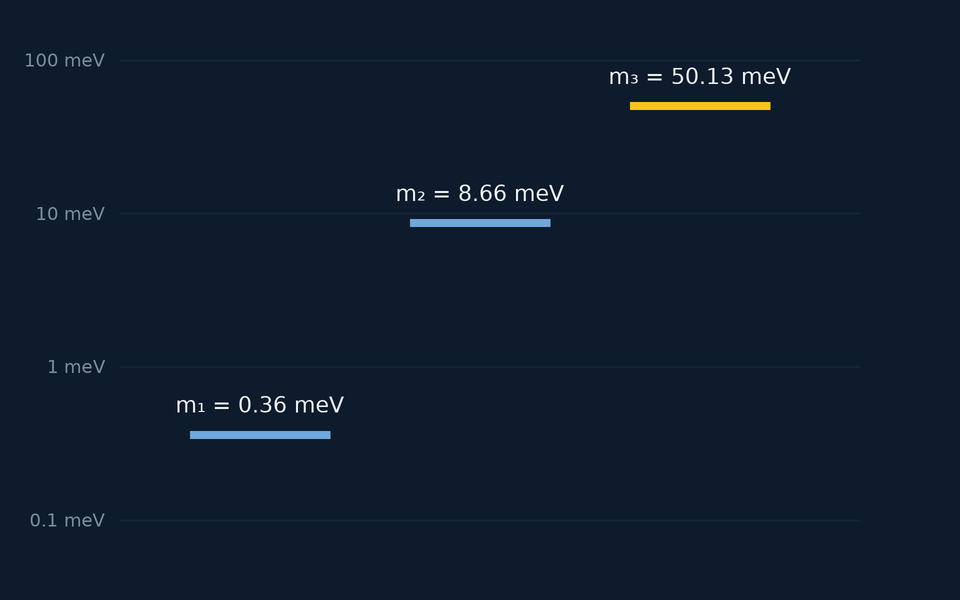
The relation that fixes the electron, muon and tau masses (Koide, 1983), applied to the two measured neutrino mass splittings, has a solution only for normal ordering. It gives m1 = 0.36 meV, m2 = 8.7 meV and m3 = 50.1 meV, with a sum of 0.0592 eV, below the current cosmological bound from DESI.
The JUNO reactor experiment is expected to determine the ordering within a few years, and cosmological surveys are approaching the sensitivity needed for the sum. Inverted ordering, or a sum clearly different from 0.059 eV, would falsify this part of the framework.
Progress on an open problem, 14 November 2026
Six quark masses from the bottom quark
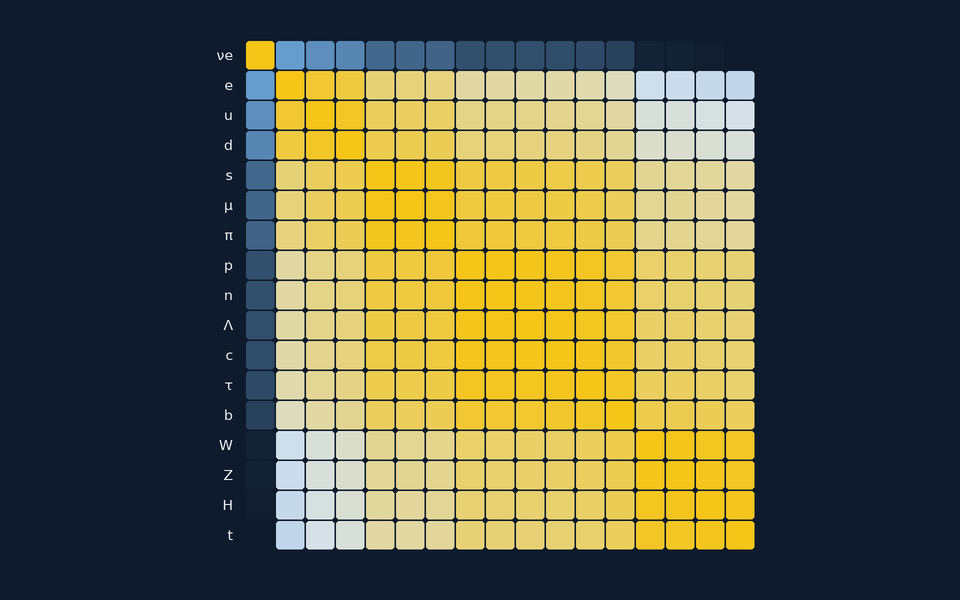
The quark masses are one of the two problems that the framework has not yet closed. Recent work uses the relational matrix, in which each pair of particles is separated by Sij = ½ ln(mi/mj), to obtain the other five quark masses from the bottom-quark mass and three relations among the matrix entries. The Cabibbo relation of Gatto, Sartori and Tonin (1968) is recovered along the way (0.2242 against a measured 0.2243).
The up quark now comes from the decay η → 3π with Leutwyler's relation, 2.08 MeV against a measured 2.16, with no input from lattice QCD. The result is still reported as partial: the bottom mass is an input, and the charm mass is consistent with measurement but not sharply determined. The figure shows the matrix for seventeen particles; darker cells are more distant relations.
Result, 14 November 2026
Curvature that changes everywhere and sums to zero

The framework holds that the geometry of space is continually changing from place to place while remaining flat on average. The simplest surface with this property is two crossing waves, z = cos x + cos y. Its Gaussian curvature is positive (curved like a sphere) over part of each cell and negative (curved like a saddle) over the rest, and by the Gauss–Bonnet theorem the total over a full cell is exactly zero. A numerical integration confirms the total to better than one part in a million.
The map shows the curvature over two cells: amber regions curve like a sphere and blue regions like a saddle. The same surface is drawn, slowly moving, at the top of the home page.
Site, 14 November 2026
A new design, and a lab for the neutron-star solver
The site has been redesigned for easier reading. The framework, the equations, the full mathematics and the validation suite each have their own page; a section for young readers tells the whole story in plain language; and the neutron-star solver is now a lab with sliders, so the effect of the containment pressure and the pairing gap can be seen directly. All calculations still run on the visitor's own device.
