What follows, with numbers
| Result | TRPG | Measured |
|---|
| Bending of starlight by the Sun | 1.752″ | 1.75″ |
| Age of the universe | 13.79 billion years | 13.79 ± 0.02 |
| Proton containment strength B, from the proton and Delta masses | 60 (57–64) MeV/fm³ | 1975 bag fit: about 57 |
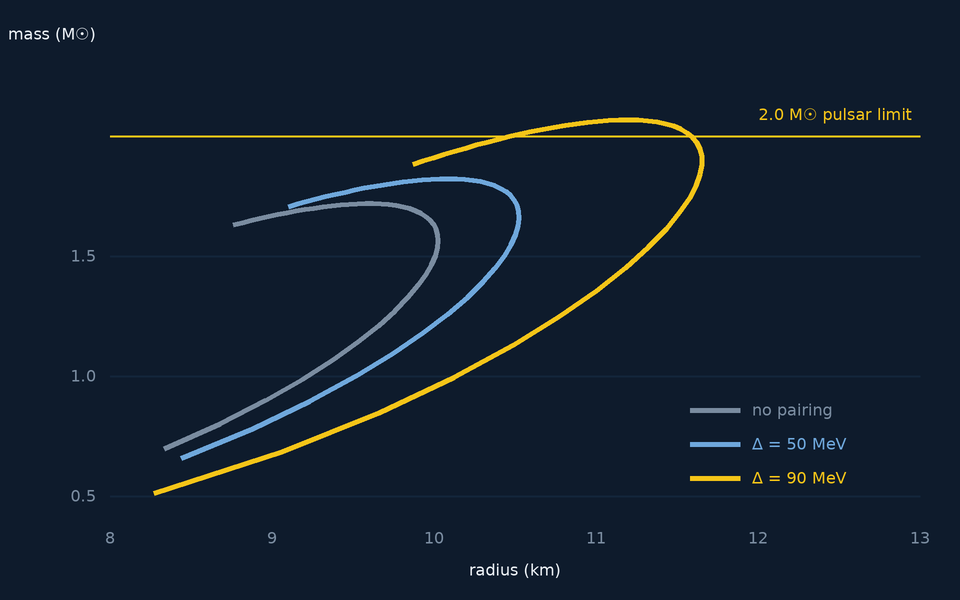
| Heaviest neutron star (B from the proton, quark pairing about 82–97 MeV) | 2.0–2.15 solar masses | at least 2.0 |
| Neutron star squeeze in a merger (tidal Λ, GW170817) | 440–580 | below about 580 |
| Electron, muon and tau masses | 3 masses from 1 scale | match to 0.003% |
| Up-quark mass, with no lattice input (η → 3π and Leutwyler's relation) | 2.04 MeV (1.73–2.29) | 2.16 ± 0.07 MeV |
| Number of quark colours and of generations (the full-bag rules lead to the octonions; “at most 3” generations holds on the alternative 4 × 4 picture; on the main picture it rests on the nothing-extra rule and measurement) | 3 and 3 | 3 and 3 |
| Cabibbo angle, from quark masses (already known: Gatto, Sartori and Tonin, 1968) | 0.2242 | 0.2243 |
| Tau lifetime, from the muon (already known: lepton universality) | 289.7 fs | 290.3 fs |
| Quark charges, given three colours (anomaly cancellation) | +2/3, −1/3 | same |
| Black hole ringdown (GW150914) | 250 Hz, 4.0 ms, no echoes | matches |
The predictions that could prove it wrong
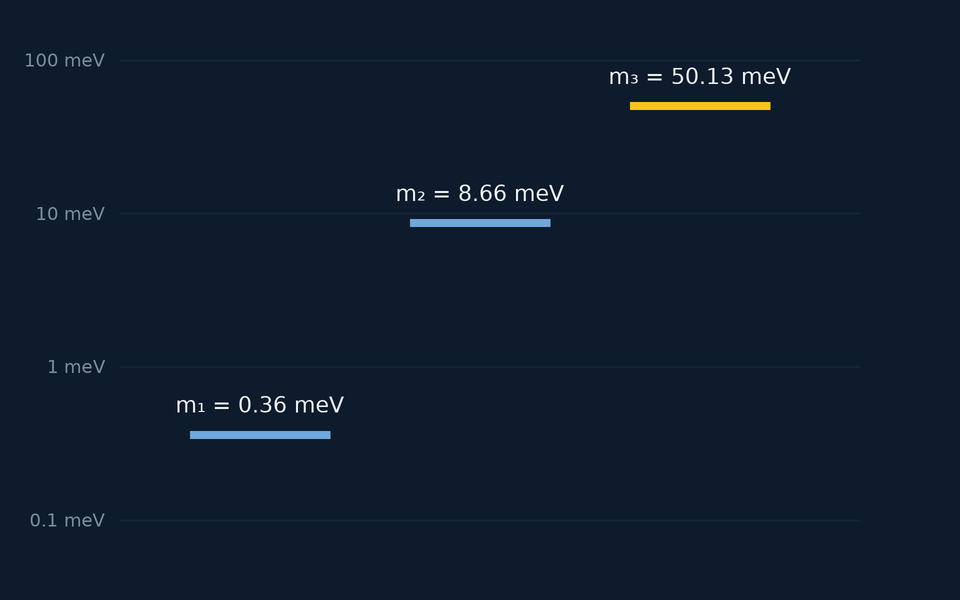
Neutrinos follow the same relational rule as the electron, muon and tau. With today's limit from cosmology on their total, that rule gives normal ordering, with masses of 0.36, 8.6–8.7 and 50.1–50.3 meV, which add up to 0.0591 to 0.0594 eV, depending on the measured splittings.
The JUNO experiment and sky surveys such as DESI can test this within a few years. If neutrinos turn out to have inverted ordering, or a clearly different total, this part of TRPG is wrong. The total is only just above the smallest total normal ordering allows (0.0588 eV), so the most distinctive number is the lightest mass, 0.36 meV.
Second, with B set by the proton, neutron stars pass both tests only if quarks in their cores pair up with a pairing gap of about 82 to 97 MeV (75 to 108 across the proton's range of B). Theory estimates 50 to 150 MeV, and it has not been measured yet.
Third, if neutrino flavours are perspectives of one neutrino (the TM1 mixing pattern), the matter–antimatter phase of neutrino mixing should be near 270° (253–292°). Current data lean towards 180–215° but cannot yet decide; DUNE and Hyper-Kamiokande will.
Fourth, the strengths of the forces meet only if the strong coupling is 0.1178. The most precise measurement so far, 0.11873 ± 0.00056, lies 1.7 standard deviations above it and does not yet decide; lattice calculations at about 0.3% will. All ten dated predictions are listed on the Results page.
Where it stands, honestly
Against the nine requirements a Theory of Everything must meet, TRPG scores 7 PASS and 2 PARTIAL, with every script rerun. It takes about 28 measured numbers, against about 34 for the Standard Model with gravity and cosmology counted the same way (the 28 assumes every pending measurement agrees; counting only savings already confirmed it is 32, plus six stated choices; see Inputs and predictions). The tau mass and the down quark mass are saved and confirmed by measurement; the lightest neutrino mass, the Higgs mass (127.2 ± 1.5 GeV from a rule at the grain of space, against 125.13 ± 0.11 measured) and two neutrino mixing numbers are saved only if pending measurements agree. No known measurement contradicts it.
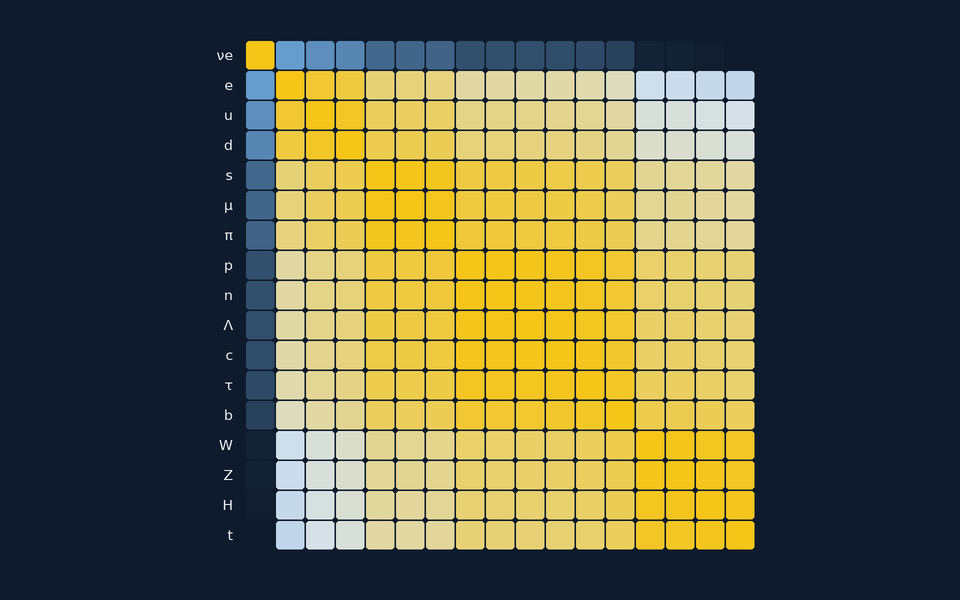
Both partial items were attacked as hard as we could, and both stay PARTIAL. Force groups (awaiting measurement): the strong force, with exactly 3 colours, follows from the full-bag rules through the octonions. The main picture reads the other forces from the 3 × 3 relationship matrix, seen from one perspective and read as a relationship among three. It gives the measured 8, 3 and 1 force carriers (a published count, reproduced here), a whole generation with the measured charges, the up-quark and electron partners included, and one-handed matter in the measured arrangement, each with a stated reading. Only the strengths remain. With the Standard Model's particles alone they miss by 8.9%. They meet if three colourless far-side weak pairs of the same matrix sit at 2.4 × 10⁸ GeV, and that requires a strong coupling of 0.1178. The most precise measurement so far is 0.11873 ± 0.00056, which does not yet decide, so this is not counted as established until the measurement returns. “At most 3” generations rests on the nothing-extra rule and on measurement. Quark masses (awaiting a rule): two links pass strict tests: the down quark from the Cabibbo angle, and the up quark at 2.04 MeV from η → 3π with no lattice input (within 0.4σ with the decay value of Leutwyler's Q, whose 3% uncertainty makes this a loose test; 2.0σ with the lattice value). The top, bottom, charm and strange masses and the quark mixing are measured inputs. The strongest lead, one heavy far-side state pressing on the down quarks, fits all ten quark numbers, but with nine free numbers, so it is a lead and not a result. The 45° relations among the heavy quarks are patterns good to 1–10%, not laws; charm misses by 15–19 standard deviations.
The heavy neutrino partners that the lepton matrix implies do not predict the matter–antimatter excess: with the lepton rule read literally they fall about 4,000 times short of the observed 6.1 × 10⁻¹⁰. The observed value is allowed through a cold start that hands its energy straight to those partners, at the cost of one measured start number. That is allowed, not predicted. Dark matter's amount is one measured number. It is read as partly perspective; the matrix allows one candidate for the rest, a cold chargeless wave (the majoron), but gives no number for it, so it is a lead and not part of the core. Neither partial item has been solved by anyone in physics, and neither is forced here.